Basement Waterproofing NJ Essentials for Long-Term Moisture Control
Basements in New Jersey have a way of revealing every weakness in a house. A heavy coastal storm, a week of slow rain, late-winter snowmelt, even a humid August stretch can turn a mostly dry lower level into a damp, musty problem zone. Homeowners often notice the symptoms first, not the cause. A faint odor near the stairs. Cardboard boxes that feel soft at the bottom. Paint that bubbles on a foundation wall. White chalky residue on masonry. A dehumidifier that never seems to shut off.
Long-term moisture control starts with a simple truth: water almost never enters a basement for one single reason. It is usually a chain of small failures. Roof runoff lands too close to the foundation. Soil pitches toward the house. Old mortar joints begin to absorb moisture. Hydrostatic pressure builds after a soaking rain. An aging sump pump works fine until the one storm that matters most. Good basement waterproofing is not just about stopping visible water. It is about understanding how moisture behaves around the structure, then interrupting its path before it causes structural damage, mold growth, wood rot, or indoor air quality issues.
That is why homeowners searching for Basement Waterproofing NJ services need more than a patch job. They need a system that makes sense for New Jersey conditions, local soil behavior, home age, foundation type, and how the space is actually used.
New Jersey basements face a specific set of moisture pressures
A lot of waterproofing advice online is generic. It treats every basement the same, whether the house sits on sandy coastal ground or dense inland clay. In New Jersey, those differences matter. Soil composition changes by region, and that affects drainage, pressure against the walls, and how quickly water moves after a storm. Older homes in towns with long-established neighborhoods may have stone or block foundations with years of wear. Newer homes can still develop seepage issues if grading was poorly finished or drainage details were rushed during construction.
Seasonal shifts add another layer. Freeze-thaw cycles can widen tiny cracks. Spring can saturate the ground. Summer humidity can create condensation problems that are mistaken for leaks. Fall is often when homeowners finally notice persistent mustiness because the windows stay closed more often. Then winter can push the whole system again, especially if melting snow collects around the perimeter.
I have seen basements that stayed dry for fifteen years and then suddenly began taking on water, not because the house changed dramatically, but because the surrounding drainage pattern did. A neighboring property added hardscaping. A downspout extension disappeared. A tree root shifted a buried drain line. The lesson is practical: basement moisture control is dynamic. Conditions around the home evolve, and the waterproofing approach has to account for that.
The difference between dampness and active water intrusion
Not every basement problem begins with puddles. Some of the most damaging moisture problems are subtle. Relative humidity stays high enough to support mold growth on stored items, floor joists, or finished wall cavities. Efflorescence forms on concrete or masonry, signaling that water is moving through the material and leaving minerals behind. Metal components rust. The space feels cool and clammy even in dry weather.
Active intrusion is easier to recognize. Water may enter where the wall meets the floor, seep through a wall crack, rise through the slab, or appear around utility penetrations. During major storms, hydrostatic pressure can force water into the basement through paths that stay dormant most of the year.
The distinction matters because the remedy is not always the same. A damp basement with no standing water may improve dramatically with exterior drainage correction, air sealing, dehumidification, and insulation upgrades. A basement that sees recurring seepage under pressure usually needs a more robust drainage and collection strategy. Treating both problems with the same canned solution often wastes money.
Why waterproof paint rarely solves the real issue
Many homeowners start with a coating because it is affordable and easy to understand. The wall looks dry, so the problem seems solved. Sometimes a masonry sealer helps with minor vapor transmission. More often, it creates a temporary cosmetic improvement while the actual pressure remains outside the wall. If water is pushing through the foundation, a coating is not removing that pressure. It is trying to resist it.
That distinction is crucial. Waterproofing is often discussed as if it were a surface treatment. In practice, effective moisture control is a https://mariofsde452.cloudhinter.com/posts/basement-waterproofing-nj-for-multi-family-and-single-family-homes drainage and pressure management issue first. Surface products can play a supporting role, but they are not the core of a durable system when water movement is persistent.
I have walked through finished basements where the owner proudly pointed to freshly painted walls, only to find damp base trim, a musty smell behind paneling, and elevated moisture readings near the slab edge. The paint was not the villain. It was simply asked to do a job it was never meant to do on its own.
Exterior water management is the first line of defense
The cheapest gallon of water to remove from a basement is the gallon that never reaches the foundation. Exterior water control often delivers the biggest return for the least disruption. That starts above grade, not below it.
Roof runoff matters more than many people realize. A single inch of rain on an average roof sends a surprising volume of water toward the perimeter. If gutters overflow or downspouts discharge too close to the house, the foundation gets loaded with unnecessary water every time it rains. Add compacted soil sloping inward and the basement is put under pressure from the top down.
Proper grading should encourage water to move away from the house. Hard surfaces like patios, walkways, and driveways should also be evaluated. I have seen one settled front walk direct enough water toward a foundation wall to create chronic seepage in the basement corner below it. The homeowner kept focusing on interior cracks, but the real culprit was six feet outside the wall.
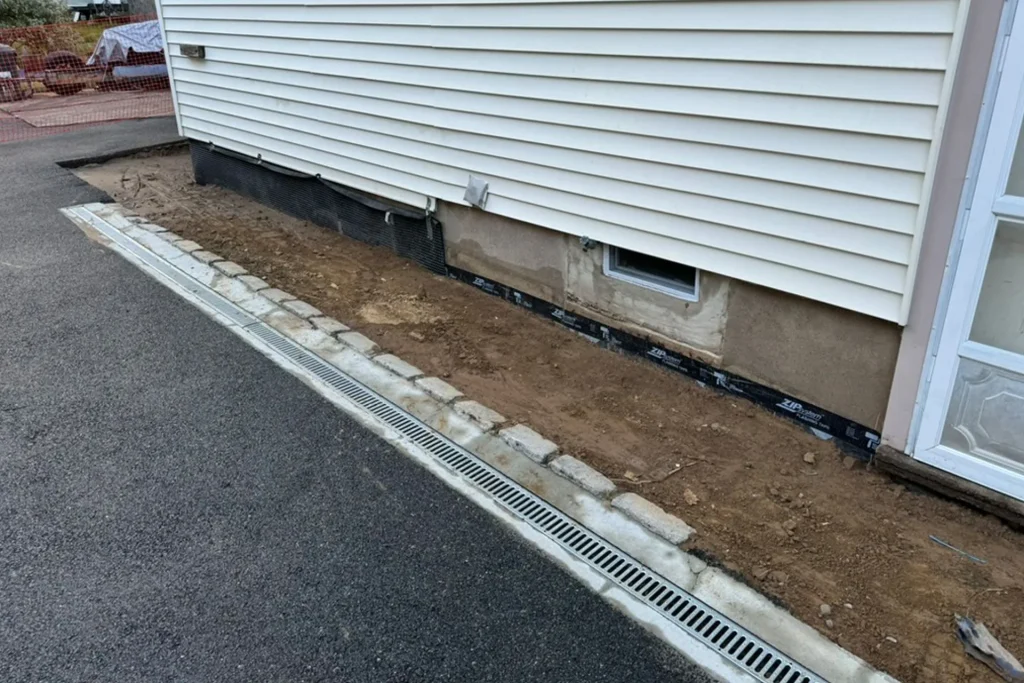
Exterior excavation and membrane systems can be highly effective, especially when the issue is localized and accessible. They are also more invasive and expensive than some homeowners expect. Landscaping, decks, porches, and tight lot lines can complicate the work. That does not mean exterior solutions are excessive. It means they need to be chosen with care, based on a clear diagnosis rather than a blanket preference.
Interior drainage systems often make sense in New Jersey homes
When outside access is difficult, when hydrostatic pressure is widespread, or when recurring seepage appears along multiple wall sections, an interior drainage system can be a very practical answer. These systems typically collect water at the basement perimeter and direct it to a sump basin for discharge. They do not stop water from reaching the outside of the foundation, but they control what happens when that water gets there.
That is an important nuance. Some homeowners hear the phrase interior system and assume it is a second-best workaround. In many cases, it is the most reliable and maintainable approach for the home’s conditions. Particularly in older New Jersey basements, where full exterior excavation is disruptive or unrealistic, properly installed interior drainage can provide stable long-term performance.
A good system is not just a trench and a pump. It includes thoughtful details such as clean drainage pathways, proper discharge routing, vapor management, and service access. If the basement will be finished, those details matter even more because hidden failures become expensive very quickly.
Sump pumps deserve more respect than they get
Most people notice a sump pump only when it fails. By then, the basement floor is already wet. A sump pump is a mechanical device, which means it should be selected, installed, and maintained with the assumption that one day it will be tested under the worst conditions.
A quality primary pump is only part of the equation. The basin size, lid fit, float switch design, discharge line configuration, and check valve all affect reliability. In New Jersey, backup power is especially important because severe storms can knock out electricity at the exact moment groundwater rises fastest. A battery backup or water-powered backup can make the difference between a close call and a full cleanup.
I remember a homeowner who had done almost everything right. The basement had perimeter drainage, crack repair, and a finished playroom. But the discharge line outside froze during a cold snap after a wet period. The pump kept cycling, had nowhere to send the water, and the basin overflowed. It was not a major design failure. It was a small oversight in discharge protection, with very inconvenient results. Basement systems succeed or fail on these details.
Crack repair is necessary, but not always sufficient
Foundation cracks make people nervous, and reasonably so. Some cracks are cosmetic. Others signal movement or create direct leakage paths. The challenge is that even a well-sealed crack will not solve a broader drainage issue if outside pressure remains high.
Epoxy and polyurethane injection methods can be effective for the right crack type. Vertical and diagonal cracks in poured concrete often respond well when the movement has stabilized. But if multiple cracks are appearing, if the wall is bowing, or if block walls show step cracking and inward pressure signs, the situation deserves a broader structural evaluation.
This is one of the most common judgment calls in Basement Waterproofing NJ work. Homeowners want a simple answer, but the right answer depends on whether the crack is the source of the problem or just one symptom. Repairing the visible opening without addressing the water load can leave the basement vulnerable elsewhere.
Humidity control is part of waterproofing, not a separate issue
A basement can stay technically dry and still have a moisture problem. This happens often in summer. Warm outdoor air enters a cooler basement and condenses on cold surfaces. The result can mimic leakage: dampness on walls, sweating pipes, moisture on the slab, and a persistent odor.
That is why any long-term plan should include humidity management. Dehumidifiers are useful, but they work best when paired with air sealing, sensible insulation, and drainage improvements. If the space is finished, material choices matter. Organic materials close to cool masonry can create ideal mold conditions. Flooring, wall assemblies, and trim details should be selected with basement realities in mind, not just main-floor aesthetics.
One practical benchmark is keeping basement relative humidity generally below 50 to 60 percent, depending on use and season. Exact targets vary, but once levels stay elevated for long periods, stored belongings and building materials begin to suffer. Homeowners sometimes spend thousands managing odors after the fact, when a better moisture strategy during renovation would have prevented the issue.
Finished basements raise the stakes
An unfinished basement can tolerate minor moisture events better because problems are visible and materials are less vulnerable. A finished basement hides evidence. Water can travel behind drywall, under floating floors, and into insulation without immediate detection. By the time a homeowner sees staining or warping, the moisture may have been active for weeks or months.
Before finishing a basement, it is wise to think conservatively. If the space has any history of seepage, mustiness, or elevated humidity, those conditions should be stabilized first. Flooring systems with some moisture tolerance usually outperform wall-to-wall carpeting in below-grade spaces. Built-ins and framing details should allow some inspection access where possible. A basement does not have to feel unfinished to remain serviceable and resilient.
I have seen expensive lower-level remodels compromised because the waterproofing discussion happened too late, after the design decisions were already locked in. It is much easier to integrate moisture control before the finishes go up than to retrofit after damage appears.
Signs that a basement needs more than a quick fix
Some warning signs are obvious. Others are easy to dismiss until the pattern becomes expensive. When several are present together, it usually points to a systemic issue rather than an isolated leak.
- Water appears after heavy rain or snowmelt, especially at the wall-floor joint.
- Musty odor persists even when the basement looks dry.
- Efflorescence, peeling paint, or rust keeps returning in the same areas.
- The sump pump runs constantly during wet weather, or not at all when it should.
- Finished materials show swelling, staining, or recurring mold at lower wall sections.
A basement with one of these symptoms may have a small issue. A basement with three or more usually needs a more complete assessment.
Choosing the right remedy means balancing cost, disruption, and risk
There is no universal best method. There is only the best method for a particular house under specific conditions. That is where experience matters. A contractor who leads with one solution for every basement is not diagnosing the problem. They are selling their preferred tool.
For some homes, regrading and extending downspouts will solve most of the issue. For others, an interior perimeter system with sump backup is the sensible core strategy. In a few cases, structural reinforcement and waterproofing have to happen together. Budgets matter, but sequencing matters too. If a homeowner cannot tackle everything at once, a good plan identifies which repairs reduce risk immediately and which can follow later.
This kind of judgment is especially valuable in New Jersey because housing stock is so varied. A mid-century poured concrete basement in a suburban subdivision behaves differently than a century-old stone foundation in a dense town. Even homes on the same street can perform differently based on lot slope, additions, drainage history, and maintenance habits.
Questions worth asking before hiring a waterproofing contractor
The quality of the diagnosis is often more important than the sales presentation. Homeowners do not need to become technical experts, but they should understand what the proposed system is meant to address and what it is not.
A useful conversation should cover the likely water source, how the recommendation manages pressure, what maintenance will be required, and how the discharge is handled outside. It should also address what happens during a power outage, whether mold-damaged materials need separate remediation, and how the solution interacts with any future basement finishing plans.
Here are a few strong questions to ask during estimates:
- What evidence tells you the water is coming from this path rather than another one?
- Does your proposed system manage liquid water, humidity, or both?
- What maintenance should I expect over the next five to ten years?
- How is the sump discharge protected from freezing, clogging, or recirculation near the foundation?
- If I finish the basement later, what limitations or precautions should I keep in mind?
Clear answers usually indicate a thoughtful contractor. Evasive or overly simplistic answers are a warning sign.
Maintenance is what turns a waterproofing job into long-term moisture control
Even the best system needs attention. Gutters clog. Downspout extensions get knocked loose. Pumps age. Exterior grade settles. Window wells fill with debris. Basement waterproofing should be thought of as a managed system, not a one-time event that can be forgotten forever.
A quick seasonal walkthrough goes a long way. Check for changes in odor, wall staining, pump activity, and exterior drainage flow. If the basement has a dehumidifier, keep the filter clean and verify that condensate drains properly. If there is a sump pump with battery backup, test it periodically according to manufacturer guidance. Small maintenance habits are cheaper than emergency restoration.
This is where long-term homeowners often have an advantage over recent buyers. They know how the basement behaves during different weather patterns. If you have just moved in, pay attention during the first full year. Basements often reveal their true character only after a full cycle of rain, summer humidity, leaf season, and winter thaw.
What effective Basement Waterproofing NJ really looks like
It is not a single product, and it is rarely a miracle fix. Effective Basement Waterproofing NJ work usually combines observation, drainage control, pressure relief, humidity management, and a realistic understanding of how the home will be used. It respects the fact that water follows physics, not wishful thinking.
A dry basement is valuable for more than storage or resale. It protects air quality throughout the house, preserves structural materials, reduces the chance of hidden mold, and gives homeowners confidence during storms. That confidence comes from systems designed around real conditions, not from cosmetic improvements that only look reassuring on sunny days.
When a basement stays dry year after year, through wet springs, summer humidity, and hard coastal storms, that is not luck. It is the result of controlling water at every stage, from roofline to soil line to drainage line to indoor air. That is the standard worth aiming for, and it is what long-term moisture control demands.
ARD Waterproofing
Address: 98 Smull Ave, West Caldwell, NJ 07006
Phone number: +12016465936
FAQ About Basement Waterproofing NJ
What is the best waterproofing method for a basement?
The best overall approach to waterproofing a basement is a combined exterior and interior system that stops water at the foundation wall and safely manages any moisture that gets through.
What is the average cost to waterproof a basement?
The average cost to waterproof a basement ranges from $2,500 to $15,000, with most homeowners paying around $5,200 for a complete project.
Can a basement be waterproofed from the inside?
Yes, a basement can be waterproofed from the inside, and it is often the most affordable and least disruptive method.